I’ve been tinkering with web analytics, and I want to share how I built this mini JS SDK. It’s got event tracking, batching with retries, and IndexedDB persistence—no frameworks, just pure JS. Let’s jump in.
By the end, we’ll have a foundation that can be extended further.
Here’s the rough architecture diagram:
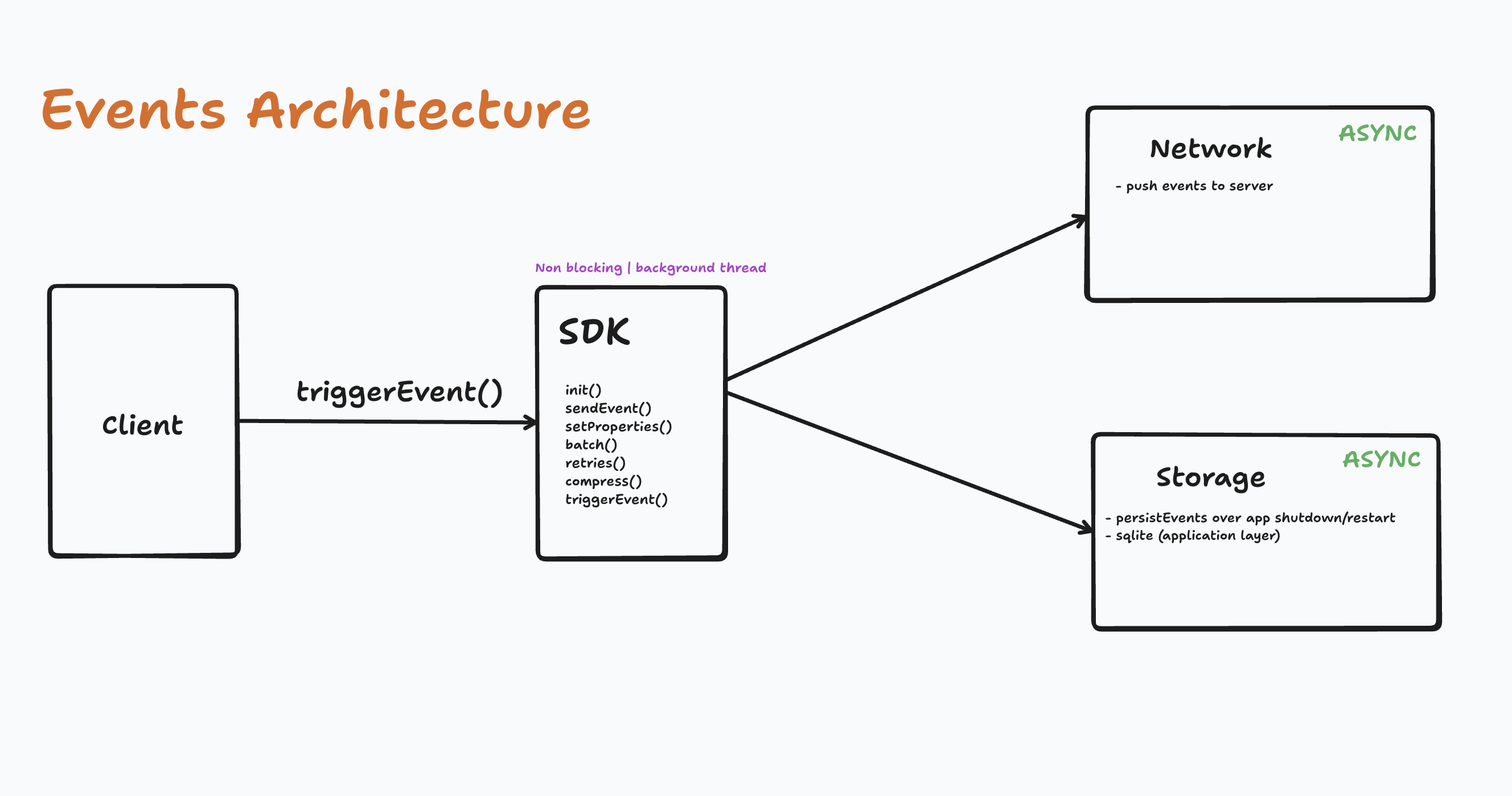
I started with a simple in-memory queue to hold events. The AnalyticsSDK class takes an endpoint and batch size (default 5). When tracking an event, I create an object with name, properties, and timestamp, then push it to the queue.
class AnalyticsSDK {
  constructor({ endpoint, batchSize = 5 }) {
    this.endpoint = endpoint;
    this.batchSize = batchSize;
    this.queue = [];
  }

  track(eventName, properties = {}) {
    const event = {
      name: eventName,
      properties,
      timestamp: Date.now(),
    };
    this.queue.push(event);
  }
}
Adding Some Smarts: Batching and Sending It Out To cut network calls, I batch events, compress them, and send via POST. Compression via CompressionStream API shrinks payloads by 60-80%.
async flush() {
  if (this.queue.length === 0) return;
  const batch = this.queue.splice(0, this.batchSize);

  const json = JSON.stringify(batch);

  const compressed = await compressData(json);

  await fetch(this.endpoint, {
    method: "POST",
    headers: {
      "Content-Encoding": "gzip", // tell server it’s compressed
      "Content-Type": "application/json",
    },
    body: compressed,
  });
}

// Utility for compression
async function compressData(data) {
  const encoder = new TextEncoder();
  const stream = new Blob([encoder.encode(data)])
    .stream()
    .pipeThrough(new CompressionStream("gzip"));

  const chunks = [];
  const reader = stream.getReader();
  while (true) {
    const { done, value } = await reader.read();
    if (done) break;
    chunks.push(value);
  }
  return new Blob(chunks);
}
Handling the Inevitable: Retries with Backoff For resilience, I added retries with exponential backoff—up to 3 tries, starting with 1-second delays.
async flushWithRetry(retries = 3, delay = 1000) {
  for (let i = 0; i < retries; i++) {
    try {
      await this.flush();
      return;
    } catch {
      await new Promise((res) => setTimeout(res, delay * (i + 1)));
    }
  }
}
Saves data during network flakiness
Bringing in the Big Guns: IndexedDB for Persistence For offline persistence, I used IndexedDB—async, large capacity, non-blocking. Created an EventStorage class for save, getAll, and clear.
class EventStorage {
  constructor(dbName = "AnalyticsDB", storeName = "events") {
    this.dbName = dbName;
    this.storeName = storeName;
    this.dbPromise = this.init();
  }

  async init() {
    return new Promise((resolve, reject) => {
      const req = indexedDB.open(this.dbName, 1);
      req.onupgradeneeded = (e) => {
        const db = e.target.result;
        if (!db.objectStoreNames.contains(this.storeName)) {
          db.createObjectStore(this.storeName, { autoIncrement: true });
        }
      };
      req.onsuccess = (e) => resolve(e.target.result);
      req.onerror = (e) => reject(e.target.error);
    });
  }

  async save(event) {
    const db = await this.dbPromise;
    return new Promise((resolve, reject) => {
      const tx = db.transaction(this.storeName, "readwrite");
      tx.objectStore(this.storeName).add(event);
      tx.oncomplete = () => resolve();
      tx.onerror = (e) => reject(e.target.error);
    });
  }

  async getAll() {
    const db = await this.dbPromise;
    return new Promise((resolve, reject) => {
      const tx = db.transaction(this.storeName, "readonly");
      const req = tx.objectStore(this.storeName).getAll();
      req.onsuccess = (e) => resolve(e.target.result);
      req.onerror = (e) => reject(e.target.error);
    });
  }

  async clear() {
    const db = await this.dbPromise;
    return new Promise((resolve, reject) => {
      const tx = db.transaction(this.storeName, "readwrite");
      tx.objectStore(this.storeName).clear();
      tx.oncomplete = () => resolve();
      tx.onerror = (e) => reject(e.target.error);
    });
  }
}
Tying It All Together in the SDK Integrated storage: Restore queue on init, save events to both queue and DB, flush on batch size hit. After flush, clear DB and re-save remaining.
class AnalyticsSDK {
  constructor({ endpoint, batchSize = 5 }) {
    this.endpoint = endpoint;
    this.batchSize = batchSize;
    this.queue = [];
    this.storage = new EventStorage();
    this.restoreQueue();
  }

  async restoreQueue() {
    this.queue = await this.storage.getAll();
  }

  async track(eventName, properties = {}) {
    const event = { name: eventName, properties, timestamp: Date.now() };
    this.queue.push(event);
    await this.storage.save(event);

    if (this.queue.length >= this.batchSize) {
      this.flushWithRetry();
    }
  }

  async flush() {
    if (this.queue.length === 0) return;
    const batch = this.queue.splice(0, this.batchSize);

    const json = JSON.stringify(batch);

    const compressed = await compressData(json);

    const response = await fetch(this.endpoint, {
      method: "POST",
      headers: {
        "Content-Encoding": "gzip", // tell server it’s compressed
        "Content-Type": "application/json",
      },
      body: compressed,
    });

    if(response.status === 200) {
      this.storage.clear();
    }
  }

async function compressData(data) {
  const encoder = new TextEncoder();
  const stream = new Blob([encoder.encode(data)])
    .stream()
    .pipeThrough(new CompressionStream("gzip"));

  const chunks = [];
  const reader = stream.getReader();
  while (true) {
    const { done, value } = await reader.read();
    if (done) break;
    chunks.push(value);
  }
  return new Blob(chunks);
}


  async flushWithRetry(retries = 3, delay = 1000) {
    for (let i = 0; i < retries; i++) {
      try {
        await this.flush();
        return;
      } catch {
        await new Promise((res) => setTimeout(res, delay * (i + 1)));
      }
    }
  }
}
Wrapping Up the Adventure There it is—a solid SDK foundation for tracking, batching, retrying, and persisting. Expand as needed; love hearing your tweaks!
References: